Monday 28th July 2025
Why now is the sweet spot for active bond management

The global bond market is in flux. Yield curves are steepening, volatility remains elevated, and policy decisions are moving markets in ways that upend some of the more reliable patterns of the last decade. In this environment, active management and selective risk positioning across the curve isn’t just preferable – it’s essential.
The volatility currently seen in bond markets is being fuelled by a combination of macroeconomic forces. In the US, ballooning fiscal deficits and a new US$3.8 trillion tax bill are putting upward pressure on long-term interest rates. At the same time, foreign demand for US Treasuries appears to be weakening. Central banks are reducing interest rates, yet are constrained in their influence over longer-dated bonds. Meanwhile, Australia faces a decade of projected deficits of its own, and our yield curve continues to respond more to global forces than domestic settings.
These pressures are driving significant steepening in the yield curve – that is, the difference between short- and long-dated bond yields – according to Phil Strano, Head of Fixed Income at Yarra Capital Management. As an active manager, Strano can hardly keep the smile off his face at the situation: steepening curves allow skilled credit managers to adjust risk exposure and capitalise on price differences.
“In this environment, extending the maturity of our bond holdings has become more appealing, particularly given longer-term bonds can offer stronger price gains as they approach maturity – a dynamic we term ‘rolldown’,” says Strano. “At the same time, we’re also seeing anomalies in credit spreads, where less-sophisticated investors are prioritising yield over relative value, creating pockets of possible mispricing.”
This is where active management proves its worth, contends Strano. Passive bond funds are bound by index rules: they cannot reposition for anticipated curve moves, nor can they selectively add risk when prices dislocate. But managers like Strano and his team can position their fund exactly where they want.
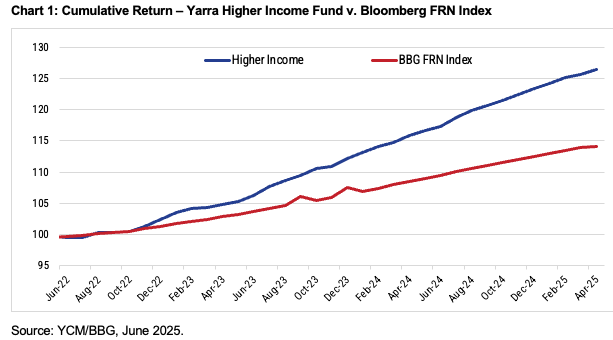
“Given the Bloomberg AusBond Credit FRN Index is more highly rated (at an average AA– compared to BBB) with shorter spread duration (about two years compared to about three), the Yarra Higher Income Fund (HIF) is well-placed to outperform during risk-on periods (as shown in the accompanying chart)” says Strano. “However, it can also be inferred that HIF’s outperformance in risk-off periods illustrates the clear benefits of active management. HIF outperformed the index through 2022 in an environment of both higher bond yields and credit spreads, and more recently, in April 2025.”
The fund’s outperformance in April provides a clear recent example of how nimble decision-making up and down the curve can combine to maximise risk-adjusted returns, he says. While the FRN Index posted a negative excess return of 11 basis points (bps) compared to the RBA Cash Rate, HIF posted a positive 32 bps excess return, despite credit spreads widening by 20-30 bps over the month.
“In April, we started the month expecting volatility around geopolitical events, which prompted us to lift cash levels and position our portfolios with higher overall interest rate duration. Crucially, we also implemented this with a steepening bias; in other words, a view that long-term interest rates would rise faster than short-term rates,” says Strano. “By focusing our exposure on the front of the curve, or short-term bonds, and being underweight long-term bonds at the back end, we were well-positioned when the long end sold-off sharply while the short end remained stable.”
In terms of stock selection, he says April also presented “some fantastic buying opportunities” for Yarra Capital to take advantage of spread widening and add high-quality credit exposures at discounted levels. “One such name was the USD-denominated Perenti 2029 bonds, an issuer we had previously sold at tight spreads of bank bill swap rate (BBSW)+180bps, and were able to buy back about 200 bps wider (BBSW+380bps). Credit spreads have since contracted about 100 bps from these ‘wides,’ providing a tidy return on investment.”
While the fund’s portfolio positioning has not changed markedly from 12 months ago, Strano says these two recent examples show how Yarra Capital is actively managing nimble, benchmark-unaware portfolios that are more ‘all-weather’ credit in nature. “Our April performance, in which both Yarra’s Enhanced Income Fund (EIF) and Higher Income Fund (HIF) posted positive absolute returns, underscores the value of our approach. Our strategy came together as a result of preparation, speed, and conviction, none of which are available to passive strategies.”
Looking beyond the tactical wins, he says the case for active credit is supported by the broader macro context. “While spread volatility continues, outright yields in the front and mid-parts of the curve have held steady. That means the income on offer remains attractive – and investors are simply being rewarded through a different mix of risk premia. The flexibility to shift between spread and rate risk allows us to preserve capital and position for growth, depending on where the market is offering best value.”
All taken together, “it’s a powerful setup,” says Strano. “Investment-grade credit today is offering yields that, on a 12-month view, look comparable to long-term equity market returns – but without the same drawdown risk. Across the spectrum, private credit looks less compelling: the illiquidity and default risk required to justify allocations to private credit simply aren’t being compensated for, in this environment.”
Looking ahead, Yarra Capital sees the drivers of this opportunity set – fiscal over-reach, inflation variability, and steepening curves – as persistent features of the bond market over the next 6 to 12 months. “This is a sweet spot for credit investing. High running yields and steeper curves, allowing active positioning across durations, are compelling, and signal that the era of ‘buy everything and wait’ in fixed income is over,” says Strano. “Today’s market rewards clarity of view, agility of execution, and a willingness to lean into volatility when others step back.”

James is an experienced senior journalist and editor of The Inside Network's publications.