Monday 21st February 2022
The driving force behind a metal super-cycle
The global shift towards decarbonisation is happening and accelerating at a rapid rate, to ensure the removal and reduction of carbon dioxide in the atmosphere and to keep temperature rises to below 1.5 degrees centigrade above pre-industrial levels.
This shift to reduce the environmental impact together with the pandemic saw an acceleration in “green” stimulus programs focused on creating economic growth through green infrastructure and renewable energy programs. However, the road to recovery is a long and arduous one, and we are still a long way from hitting the required green targets, according to fund manager Ausbil.
Ausbil has released a research and insights piece titled “A rapidly changing world is changing resources demand,” which looks at the opportunities in decarbonisation. And they are nothing short of overwhelming. They range from clean energy, electric vehicles, clean supply chains, a circular economy and the tech-enabled electrification-and-internet-of-things.
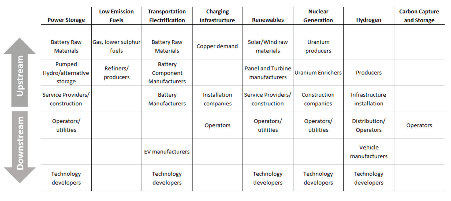
Looking at the table above, a range of opportunities begin to appear with rapid decarbonisation. The manager’s Ausbil Global Resources fund has three major areas of resources demand: power generation, transmission and storage. Much of the country has old fossil fuels like thermal coal, oil, diesel and natural gas.
Ausbil says, “Solar power generation has been around for many years. The main driver of increased solar production through the years has been a reduction in cost and increases in the efficiency of panels. Once panels are produced, there are no emissions from solar generation.
“Wind generation has also been around for many years and, like solar, technology has seen efficiency increase, and costs fall. Wind generation can be small-scale in remote applications or built up into onshore or offshore wind farms. Wind generation is also clearly weather-dependent. Large onshore wind turbines can generate about 5MW (150m diameter turbine), enough to power around 1,100 homes daily. Whereas large offshore wind turbines can generate about 15MW (236m diameter turbine), enough to power about 3,300 homes per wind turbine,” says Ausbil.
Nuclear power generation does give investors the opportunity to own a carbon-free energy source that reduces emissions production. However, while theoretically a green stock, investors are still feeling the pain from reactor failures such as Chernobyl (1986) and Fukushima (2011) that endangered lives. Despite significant technological improvements that have increased safety in nuclear power generation, people are still apprehensive.
The area that is showing the most promise is “green hydrogen,” that is, hydrogen produced using renewable energy. Ausbil says: “another old-but-new technology, hydrogen, has surfaced recently as another potentially critical part of the future energy complex. Hydrogen can be produced as needed through a chemical reaction, it can be made ‘green’, and it can make use of existing gas and energy infrastructure, including as an alternative vehicle fuel source.”
All in all, decarbonisation is the driving force that will support resources and metals demand used for renewable energy generation in the years ahead. Ausbil says, “this shift towards renewables and decarbonisation is instigating a dramatic commodity-led response. We are seeing a staggered change in commodity demand for commodities related to the new energy theme, while structural headwinds are in place for fossil fuels. Demand trends are changing fast, and that creates significant opportunities for a fund such as ours, both on the long and short side.”


Ishan is an experienced journalist covering The Inside Investor and The Insider Adviser publications.