Thursday 12th June 2025
Stewarding capital through the climate age
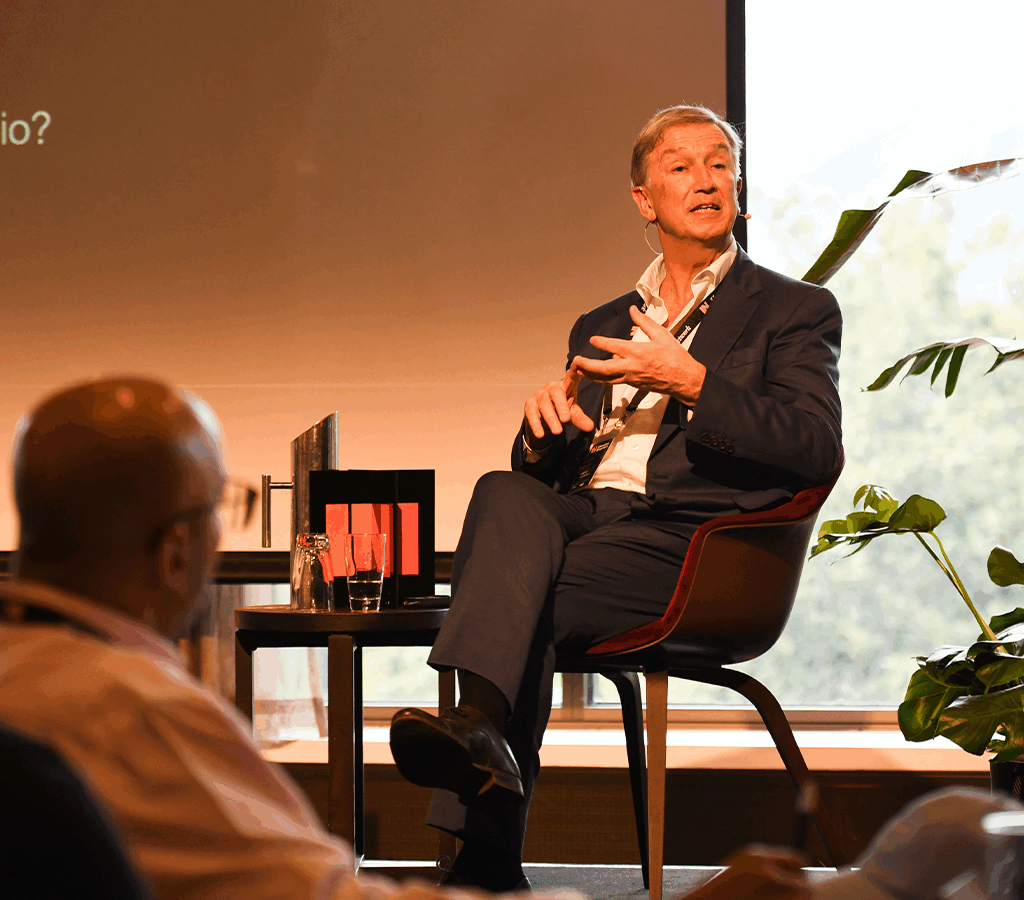
John Woods, deputy chief investment officer at Australian Ethical, knows that investing ethically isn’t about feeling good—it’s about thinking long. At The Inside Network’s Equities & Growth Symposium, Woods delivered a comprehensive and, at times, sobering take on where values-driven capital fits in a world facing economic uncertainty, climate urgency, and geopolitical rupture.
More than anything, his comments suggested that true responsible investing is neither simplistic nor niche — it’s complex, rigorous, and now absolutely central to portfolio construction.
Australian Ethical’s approach, Woods explained, rests on three foundational pillars: long time horizons, total portfolio thinking, and resourcing. Its high-growth fund targets CPI-plus 4.5 per cent over 10 years, and rather than trying to outguess the moment, the firm builds portfolios to perform across scenarios — war, inflation, COVID, trade friction. “This is its own unique crisis, but the ingredients are familiar,” he said. With that mindset, the investment team can stay the course even as markets convulse. Diversification, particularly into currencies and private assets, has helped smooth returns, and a large internal and external team enables the firm to be both reactive and resilient.
That scale matters now. “These are the moments we get paid for,” Woods said. “There are hundreds of decisions to be made. You can’t do it all from the top down.” With dispersion across asset classes widening and risk premia resetting, Australian Ethical is leaning into its active capabilities to redeploy capital into areas offering the best long-term reward. Those areas, increasingly, are outside the conventional benchmarks. In global equities, they’ve pivoted to a more quantitative approach. At home, it prefers a “blue team” model—bottom-up, quality-focused and benchmark-aware.
Woods is frank about the impact of politics, especially the re-emergence of Trumpism and its implications for climate policy. But he doesn’t view political headwinds as a reason to abandon climate-linked assets — quite the opposite. “When you make a problem bigger, it needs more capital to solve,” he said. The shift away from government-led climate action simply increases the need — and the opportunity — for private capital to step in. Already, Canadian pension funds are snapping-up discounted renewable infrastructure, and names like First Solar have rebounded as investors recalibrate. “That’s capital coming back into the space,” he noted, adding that even Trump’s disruptive return may catalyse renewed investor focus, not retreat.
But not every green asset is worth owning. Woods is particularly wary of the thematic ESG boom that saw investors chase anything solar or wind-related at inflated valuations. “Valuation matters,” he said. “We can’t fund this transition if our capital gets stranded.” He cited Japan’s wind sector, where cash yields didn’t justify the hype, as a cautionary tale. In contrast, Australian Ethical’s preference for diversified themes and rotating allocations — 13 themes, 13 managers — has allowed it to reallocate toward more compelling opportunities as they emerge, avoiding the trap of over-committing to a single issue or sector.
The firm is also tapping private markets to access assets simply unavailable on listed exchanges. “If someone asks me for a good renewable company to invest in Australia, I have to point them to New Zealand,” Woods said. But in the private sphere, there’s more choice: repurposing and recycling businesses in Melbourne, battery manufacturing, and affordable housing assets with 10 to 15 per cent returns. “That sounds like growth to me,” he said. These assets not only enhance diversification, they also advance the firm’s ethical mandate — particularly where listed markets fall short.
Woods takes the climate financing challenge seriously — so seriously that it’s difficult not to be sobered by his numbers. “A few years ago, I saw a figure: $50 trillion needed by 2050. That scared me. Now McKinsey says it’s $150 trillion.” It’s a vast, almost inconceivable figure, equivalent to the entirety of global GDP, and yet, he points out, not without precedent. “In the Victorian era, Britain basically spent its GDP on railways. And that created massive growth.” The task ahead, he said, is to compound capital in a way that makes climate action self-funding. Stranded assets will sink the mission; profitable, growing assets can sustain it.
Importantly, Woods also distanced true ethical investing from the recent wave of ESG-labelled products that rode a fad. Where some passive ESG funds simply reweighted existing indices, Woods insists on a research-driven process rooted in rigorous screening and stakeholder feedback. “What’s good and what’s bad isn’t always black and white,” he said. “Is this social media company acceptable? Is that EV manufacturer really ethical? We debate it all.” With six full-time ethical research staff and a 30-year track record, Australian Ethical’s process has been tested through both market and moral cycles.
All this contributes to what Woods sees as a style with durable merit — not just ethically, but financially. “We’re responsible investors first. But this is also a good way to invest,” he said. Responsible investing, by its nature, avoids sectors most exposed to volatility, regulation and obsolescence. It tends to favour high-quality, forward-looking companies with pricing power and margin durability. That makes it complementary in a broader portfolio — less correlated, more resilient — and particularly well-suited to environments like the one we face now.
Ultimately, Woods believes active management is the key to unlocking value in volatile periods. “I want more people making those hard decisions — should I deploy capital today, or wait for tomorrow?” he said. By trusting active managers who are closer to the assets, he gains conviction to deploy more capital, not less, during moments of uncertainty. That’s how Australian Ethical has weathered crises before, and it’s how he intends to navigate this one: with purpose, pragmatism, and a firm belief that values and returns can not only coexist, but thrive together.

Laurence Parker-Brown is head of content at The Inside Network and managing editor of The Inside Adviser and Investor Strategy News.