Monday 12th May 2025
Size, structure and selectivity: the real work behind private credit
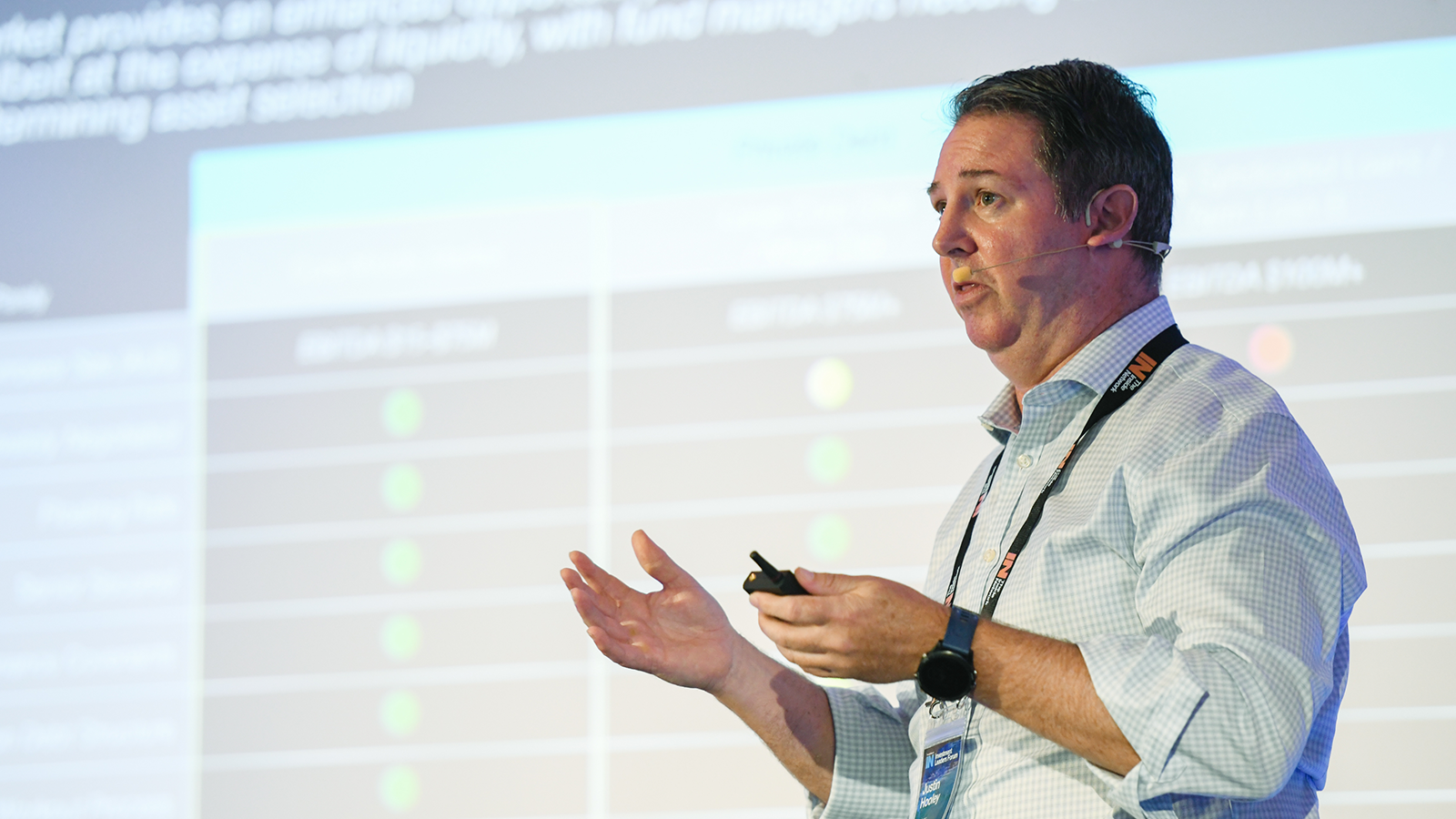
Across private wealth portfolios, private credit has become something of a buzzword – frequently cited, but often misunderstood. At the Investment Leaders Forum in Byron Bay, Justin Hooley, head of Australian private credit at Barings, brought clarity to the category with a deep dive into its structural complexity, sector segmentation, and the due diligence discipline required to navigate it well.
For Justin Hooley, head of Asia-Pacific private credit at Barings, private credit isn’t just about returns – it’s about control, alignment and avoiding the wrong kind of noise.
Hooley opened his session at the Investment Leaders Forum in Byron Bay by breaking private credit into its component strategies: senior secured first lien, second lien, mezzanine, opportunistic, and distressed debt. “Most people think of direct lending and stop there,” he said. “But the universe is far broader.” The core insight was simple: where you sit in the capital stack – and what you’re underwriting in terms of risk – will determine everything from yield profile to recovery potential. This spectrum, he explained, is not just about credit quality. It’s about investor intent.
For Barings, the sweet spot is the core middle market – companies with earnings before interest, tax, depreciation and amortisation (EBITDA) of $10 million to $150 million, operating in defensive industries, and backed by sponsors with skin in the game. “This isn’t venture capital,” Hooley said. “These are mature businesses with real cash flows and proven operators. They just don’t access the public bond markets.” The firm’s preference is for healthcare, IT services, and business support sectors – areas with resilience across cycles. Mining, real estate, retail and restaurants? “Too cyclical,” he noted. “We stay out.”
Direct lending, in this context, becomes a high-touch business. Barings prefers deals where it can originate and structure loans, not just pick up paper in the secondary market. “We want to be at the table, working with management, shaping covenants, and defining terms that protect our downside,” Hooley said. “That’s not possible in the broadly syndicated loan market, where documentation is often looser and lenders more diffuse. In the core middle market, Barings is typically one of just a few lenders; sometimes, the only one.
The firm also emphasises floating-rate structures, giving investors exposure to the prevailing rate environment while maintaining margin spreads. Today, yields on senior secured deals are comfortably in double-digits, a function of both base rates and the illiquidity premium inherent in these bespoke loans. Through the cycle, Hooley says investors should expect internal rates of return (IRRs) in the 7 per cent to 8 per cent range. “Even if rates fall, spreads adjust,” he said. “We’ve seen it before.”
But what really distinguishes Barings’ approach is its emphasis on control during distress. “Maintenance covenants matter,” Hooley said. “They let us step in early, before value is destroyed.” He contrasted this with more passive approaches in larger, syndicated deals, where dozens of lenders may be involved and governance is diluted. In Barings’ model, a tighter relationship with the borrower allows for quicker intervention, more targeted remediation, and ultimately, better recoveries.
To illustrate, Hooley walked through three real-world examples – three Australian healthcare companies with similar valuations and revenue profiles. The first was a private day-hospital operator financed through private credit. The second, a large hospital group backed by Brookfield. The third, a cancer care chain funded via public markets. The outcomes diverged significantly. The private deal, which Barings selected, offered tighter covenants and cleaner governance. The others, with more aggressive structures and less lender control, ran into operational and financial trouble. “From the outside, they looked like safer bets,” Hooley admitted. “But once you get into the documents, it’s a different story.”
This is where the real work of private credit happens – long before headlines or defaults. “We assess every deal through three lenses,” he said: issuer resilience, capital structure and sponsor behaviour. How did the company perform during COVID or the GFC? What’s the split between debt and equity? What’s the track record of the PE sponsor when things go wrong? “You don’t want to be learning that on the fly,” Hooley warned.
He closed with a checklist – useful not just for fund selectors, but for advisers and clients evaluating private credit managers. “Ask who’s doing the origination. Ask about covenants, sector exposure, deal concentration. Ask if they’ve actually worked through a credit cycle.” He acknowledged that not all private credit is created equal. “Some funds are just repackaged yield. Some are genuine capital preservation vehicles. You’ve got to know the difference.”
In an increasingly crowded market, Barings’ message was one of precision and process. Private credit is not just about accessing a new return stream; it’s about underwriting complexity, maintaining discipline, and ensuring that when capital is at risk, someone’s close enough to steer the outcome. For Hooley, that’s not just a feature of the strategy – it’s the job.

Laurence Parker-Brown is head of content at The Inside Network and managing editor of The Inside Adviser and Investor Strategy News.