Monday 22nd February 2021
Portfolio diversification through innovation - Part 3
Part 3 – Daintree Capital Core Income Trust
Sydney-based Daintree Capital is an ultra-modern, specialist absolute return funds management boutique with a primary focus on protecting client capital against downside risk.
How is Daintree innovating?
Daintree has developed an innovative short-duration, active fixed income strategy that manages risk in a ‘lower for longer’ or rising interest-rate environment. Daintree Capital says the world has changed for fixed income investors, who face a tough decision: continue to invest as usual, or accept the new normal and learn to navigate a changed landscape. Opting for the latter, portfolio managers Mark Mitchell and Justin Tyler use their expertise in an effort to deliver returns of 1.5% to 2.0% through the cycle. Portfolios include both investment and sub-investment grade bonds, along with senior and subordinated bank and industrial company debt.
What is the approach?
Having realised that an environment of exceptionally low government bond yields (or in some cases, negative real interest rates) is likely to be the new norm for years to come, Daintree Capital sought a way to achieve an acceptable level of both risk and return. The strategy is to structure the portfolio with short-duration credit and fixed income securities and cash, which provides a total return (after fees) that exceeds the RBA Cash Rate by 1.50%-2.00% a year. These securities are generally floating-rate, with these coupons the largest contributors to performance since inception.
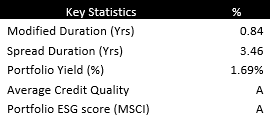
It achieves this by investing in a ‘high-quality’ portfolio of fixed income securities, with an expected average credit quality rating of A or better. Daintree also screens out coal and energy extraction companies on environmental grounds, among other exclusions such as tobacco, controversial weapons, and, for New Zealand-based clients, whale meat and cannabis.
Characteristics & Performance
The fund has been strong in 2020, with tighter credit spreads the main driver of returns. This was particularly the case in October and November following the vaccine news, with spread compression slowing in December.

Daintree Capital says there are two ways to reduce risk in a portfolio. One is to dilute it (by decreasing risk asset exposures in favour of lower beta assets or cash) and the other is to seek to actively reduce it, by seeking a low or negatively correlated exposure. However, trying to find bonds that are negatively correlated to equity markets can be problematic, as government bonds have become more positively correlated with equities. With bond investing, it’s all about avoiding losers, not picking winners – as the capital upside is constrained.-

Ishan is an experienced journalist covering The Inside Investor and The Insider Adviser publications.