Thursday 3rd July 2025
Leadership is a craft: Jim DeCarlo on building great advice firms
Leadership in wealth management is not a fixed trait. It evolves with markets, technologies and the shifting expectations of clients and staff.
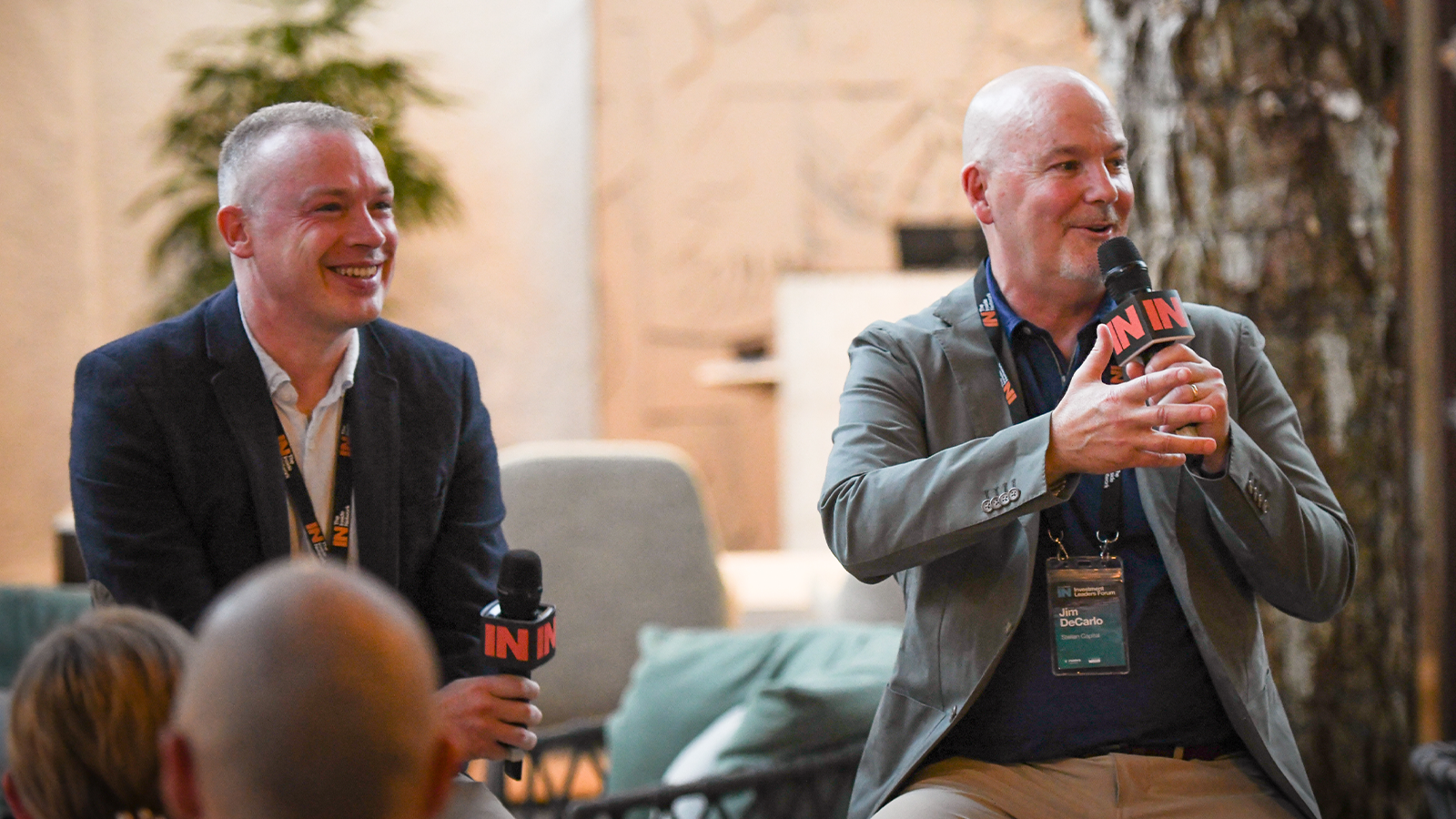
Speaking at The Inside Network’s Investment Leaders Forum in Byron Bay, veteran executive Jim DeCarlo (pictured, at right, with the author) outlined a contemporary framework for leadership that blends emotional intelligence with structured strategy. Drawing on experience across both the United States and Australia, DeCarlo offered advisers a detailed view into what it takes to lead with authenticity and create lasting value.
DeCarlo’s career spans decades and continents. He has held executive roles at some of Australia’s most innovative platforms, including Asgard and North, before moving to the US, where he transformed a boutique Maryland wealth firm, doubling its size to US$1.6 billion ($2.4 billion) in under three years. He later joined a larger acquirer and repeated the feat, scaling that firm from US$10 billion ($15.1 billion) to US$20 billion ($30.3 billion). Now back in Australia and leading Stellan Capital in Adelaide, DeCarlo continues to apply a playbook that has proven resilient across markets.
He begins with systems. Every great business, he argues, runs on two kinds: hard systems, such as tech stacks and process frameworks, and soft systems, which include culture, leadership and communication. “You hire people who are creative and entrepreneurial, and then build processes around their strengths. But the real magic comes when those systems are anchored in purpose,” DeCarlo told the forum audience. “People need a reason to come to work with their hearts, not just their hands.”
That sense of purpose is more than aspirational. It drives performance, DeCarlo says, and must be tied to strategy. He advocates for quarterly leadership off-sites, regular key performance indicators and a two-tiered leadership model that separates strategy from execution. “Too few leaders are honest about what’s really going on in their business,” he said. “You need to step outside your own frame of reference, regularly and rigorously.”
A critical part of the leadership puzzle is client experience. While technical knowledge remains essential, DeCarlo believes it is no longer a differentiator. “Advisers love their craft, but clients don’t come to you for derivatives or asset allocation,” he said. “They come for purpose, for goals, for help in managing their financial lives. The best firms build a client experience that is repeatable, that delivers to that purpose every single day.”
Hiring practices matter too. At the Maryland firm, DeCarlo made a conscious decision to build a gender-diverse team, which became majority women. Many of those hires were mentored into advisory roles. “Bluntly, I think women are naturally better at advice,” he said. “They’re more patient, more empathetic. That makes for better outcomes.” He also implemented a quarterly bonus structure to replace traditional annual schemes, a move that improved engagement and reduced staff turnover.
DeCarlo is bullish on the next generation of advisers, particularly those in Gen Z. “They’re entrepreneurial. They want autonomy and room to innovate,” he said. “If you line them up and tell them to follow a script, they’ll leave. But if you give them a say in how the business evolves, they lean in. You have to build systems that invite and support that creativity.”
This shift requires a rethinking of organisational structure. The command-and-control model, DeCarlo said, is finished. In a world of hyper-accelerated information flow, leadership needs to be more democratic. “Everyone is online, everyone is consuming content. You’ve got 50 people in the office? You’ve got 50 sets of eyes on the market. Use them.”
Looking to the United States, DeCarlo offered Australian advisers a glimpse of what scale can look like. There are more than 15,000 registered investment advisers (RIAs) in the US, with the largest managing over US$100 billion ($151 billion)in assets. Marketing is central to their success. “Marketing drives sales. Sales drives implementation. Implementation drives service. That’s the flow. And it works,” he said.
The conversation also returned often to mentorship. DeCarlo is a strong advocate for building mentoring programs within advice communities. “Leadership takes time. You don’t speed it up. You need to spend time helping others think about how they lead and grow,” he said. “It’s one of the most powerful things you can do.”
The Investment Leaders Forum in Byron Bay was the latest in a series of events hosted by The Inside Network that connect wealth professionals across borders. Sister events in Singapore (14– 17 October 2025) and Queenstown (10–12 August) will continue that mission, enabling advisers to learn from global peers and apply best practice in their own contexts. Readers of The Inside Adviser can book their seats at these events by using these links for Investment Leaders Forum INASIA and Investment Leaders Forum INZ.
As Australia’s advice sector looks to rebuild post-regulatory reform and amid shifting client expectations, DeCarlo’s reflections land with weight. Leadership, he argues, is not a title but a discipline. “You need vision, you need systems, and you need to communicate constantly,” he said. “You don’t just manage a firm. You lead it.”

Laurence Parker-Brown is head of content at The Inside Network and managing editor of The Inside Adviser and Investor Strategy News.