Thursday 3rd July 2025
Commodity contrarian sees a sector on the cusp of a climb

Adam Rozencwajg has been to Australia many times, looking for under-valued mining and oil and gas stocks for his portfolio: and there’s nothing he loves more than getting out among the red soil, the ore trucks, the pits, shafts and processing plants, and the high-vis clothing. But this time, he was looking for investors.
Adam Rozencwajg’s most recent visit to Perth felt a bit off. “Yes, it was a bit strange being in Perth, talking to people in suits, and not heading out to go visit any sites,” he says. Instead, he spent his time indoors, pitching his new fund to wealth management firms, as part of an Australian sales trip.
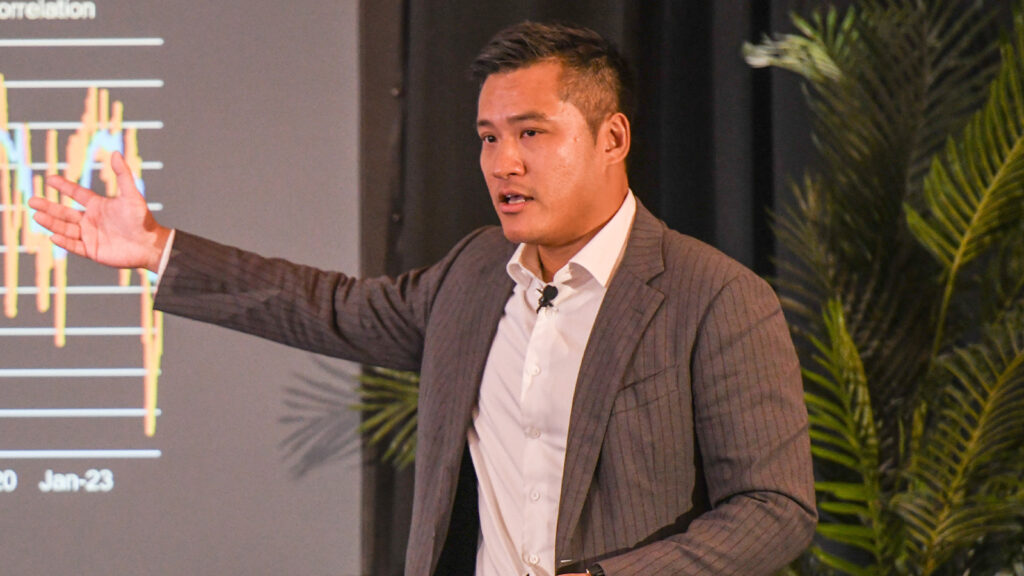
Rozencwajg (pictured) is managing partner at New York-based Goehring & Rozencwajg (G&R), a specialist natural resources investment firm with more than $1.2 billion in assets under management. The firm was established by Rozencwajg and his partner Leigh Goehring in 2016, but the latter has been managing the strategy since 1991, first at Prudential, then at a hedge fund called Chilton Investment Company, which Rozencwajg joined in 2007.
G&R has had Australian family office and high-net-wealth investors since inception, but recently decided to launch a dedicated Australian fund aimed at the local wealth market, assisted by local funds management platform provider Mantis Funds and Swiss-based ARM Capital.
Australia is “a natural choice” for the firm as a market, says Rozencwajg. “The Australian market has a deep understanding of the resources landscape that’s simply unmatched globally. From retail investors to institutions, Australians intuitively grasp commodity cycles in ways other markets don’t. We’ve had strong interest from family offices, advisers, and even some super funds. This fund is simply the right product at the right time, in a market that understands the opportunity.”
Over the 34 years that it has handled clients’ money, the G&R strategy has focused on commodities and natural resources equities: the firm has built a reputation for deep-value, contrarian, cycle-aware resource investing, seeking out under-valued sectors that have been starved of capital and are poised for cyclical rebounds. “We almost always prefer equity exposure. One exception to that right now is that we hold some Sprott Physical Uranium Trust (the world’s largest physical uranium fund, which trades on the Toronto Stock Exchange),” says Rozencwajg.
The firm seeks to buy companies at steep discounts to their net present value (NPV), with a view to optionality, embedded resources in the ground, and rising commodity prices. “We’re value managers, we want to buy when no one else is interested, and then patiently wait for the rerating,” he says.
Since inception on the last day of 2015, the G&R Global Natural Resources Strategy has handily outperformed its benchmark, the S&P Global Natural Resources Stock Index (both expressed in A$) – in fact, over the last five years, the strategy has doubled the benchmark’s return – but like many active funds, performance has been middling against an increasingly concentrated sharemarket in love with the “magnificent seven.” However, G&R believes that right now, commodity equities are as undervalued today as they have been at any point in the last century.
“Leigh and I believe the time to buy natural resource equities has arrived. Barring the brief, COVID-induced plunge, commodities are now as undervalued relative to stocks as they have ever been. Fresh research suggests that the tide is about to turn – that the long-dormant natural resource bull market may be stirring once again,” he says. “Energy and materials typically make up 15 per cent–16 per cent of the S&P 500 index, but today, that proportion is just 3 per cent. Picking the exact bottom is difficult, but by every metric we measure, we are there – or very close. We think this signals a massive opportunity.”
But not all commodities are equally attractive in this scenario. Those that G&R likes right now are:
- Oil and Gas: Under-capitalised, strong supply/demand dynamics.
- Uranium: High conviction; clean-energy alternative with long-term potential.
- Gold: Bullish, especially on Canadian gold stocks trading at low valuations with high margins.
- Coal: Especially HELE (High-Efficiency, Low-Emission) coal; starved of capital and banking access, creating contrarian upside.
Gold is the biggest exposure currently, with uranium the second-largest. “We don’t care what the benchmarks look like – we go where the fundamentals and the value tell us to go,” says Rozencwajg. “Sometimes we’ll have up to 25 per cent of the portfolio in gold stocks, sometimes that will be less than 4 per cent. For about the last 18 months we’ve had gold at more than 21 per cent,” he says. “We have about 20 per cent in uranium, but for many years, we had no uranium at all.”
The firm is “steadfastly” a uranium bull. “I think that uranium has an unbelievably bright future and will probably be the most important single investment and societal theme in our lifetime,” says Rozencwajg. “People are beginning to realise that we are in an energy-short world, and that nuclear is far and away the most efficient source of power and energy man has ever harnessed.”
Concomitantly, G&R is not a huge fan of renewables. “Really, for a new technology to displace an old one, it needs to be more energy-efficient than the old one. We’ve never had an example of widespread adoption of new technologies that are less energy-efficient; and both renewables – and electric vehicles (EVs), for that matter – are less energy-efficient, and that’s why I think they struggle,” he says.
“Governments can certainly mandate them; but ultimately, in the case of renewables, they require a lot of input energy, and they require a lot of input capital, and the last 15 years have been unique for really cheap capital and really cheap energy, and that’s what’s made them work. If we are talking about the world seriously ‘decarbonising,’ then we would advocate nuclear energy as the realistic path.”
The firm is also “not so bullish” on lithium. “Lithium is probably the one commodity that has had lots of capital investment in the last several years. We prefer to look at commodities where there’s been a real dearth of capital spending. Last cycle, there was a lot of spending in iron ore, and so that’s why it’s still been a choppy market – It has to be digested. And this cycle, the one area that’s had no shortage of capital has been lithium. So, we’re actually the least excited about lithium compared to things like oil, natural gas, uranium, gold, and even copper – we’re at roughly half position in copper, at less than 10 per cent of the portfolio.”
The firm will go ‘exotic,’ into the far reaches of the periodic table, but has not done so in the current cycle. “We were huge investors in the rare earths in the last cycle, and we actually invested quite well. But we’ve been on the sidelines, in the current cycle, with rare earths and lithium; we think that over-investment and political interference – particularly from China – have distorted pricing and fundamentals.”
The new Australian fund, the Goehring & Rozencwajg Global Resources Trust, was launched on 1 May 2025 and currently has funds under management of just over $20 million. Denominated in A$ but unhedged to the underlying portfolio, the fund offers three unit classes:
- Founders/Seeders: minimum investment $5 million, management fee 0.65 per cent a year;
- Class A units: minimum investment $1 million, management fee 0.85 per cent a year; and
- Class B units: minimum investment $25,000, management fee 1.25 per cent a year.
The Australian fund is structured as a standalone fund, not a feeder: it will hold the same portfolio as G&R’s global flagship strategy. There is no performance fee, no buy/sell spread, and the fund offers daily liquidity.
James is an experienced senior journalist and editor of The Inside Network's publications.