Monday 8th September 2025
Clients want confidence, control – not just returns: Russell

While implementing an investment strategy that dovetails with an investor’s life goals is always critical, new research reveals they place at least as much weight on emotional and behavioural benefits.
Good financial advice gives clients confidence, control and peace of mind, according to research from Russell Investments, a global investment solutions partner.
Findings from the 2025 Value of an Adviser Report show that the emotional and behavioural benefits of advice are just as important as technical expertise about investments – and may even carry more weight in client satisfaction.
Among advised clients:
- 89 per cent say feeling confident and knowledgeable about their finances is the top financial benefit of advice.
- 86 per cent cite feeling more in control of their finances as the top emotional benefit.
- 81 per cent say they are extremely confident in achieving their financial goals – compared with only 28 per cent before receiving advice.
In contrast, 57 per cent of unadvised investors are only moderately or slightly confident about managing their money, and three quarters (76 per cent) say they would feel more in control if they engaged an adviser.
Russell’s Neil Rogan (pictured), head of distribution, Australia and New Zealand, says advisers have always been technical experts, but this research shows their real competitive edge is helping clients feel calm, capable and in control.
“However, advisers and clients don’t always see value the same way,” he says. “While 70 per cent of advisers believe their main financial contribution is helping clients avoid costly mistakes during periods of market volatility, only 28 per cent of clients agree.
“Conversely, 86 per cent of clients identify feeling in control of their finances as the top emotional benefit, while advisers rank it third. Understanding and closing these gaps will help advisers create more meaningful relationships.”
The report – in its eighth year – surveyed 700 Australian investors (advised and unadvised) and nearly 200 financial advisers in the April-June 2025 quarter.
The report found that advice drives client satisfaction and confidence, with 85 per cent “feeling supported in making decisions aligned with their lifestyles”. And at 84 per cent was the belief that their advisers “offered good or excellent” value.
At 40 per cent, retirement planning is cited by advised clients and unadvised investors as the main reason for seeing an adviser, with 42 per cent of the former retiring before 65 compared with 20 per cent of retirees who don’t have an adviser.
On market volatility, the report says it challenges even experienced investors. The first half of 2025 delivered dramatic swings – global share markets hit record highs, plunged in response to US President Donald Trump’s “Liberation Day” tariff announcement and then rebounded – with history showing retail investors are among the most likely to panic sell in such situations.
“Studies show that missing just the 10 best trading days over a decade can reduce gains dramatically (see chart),” the report says.
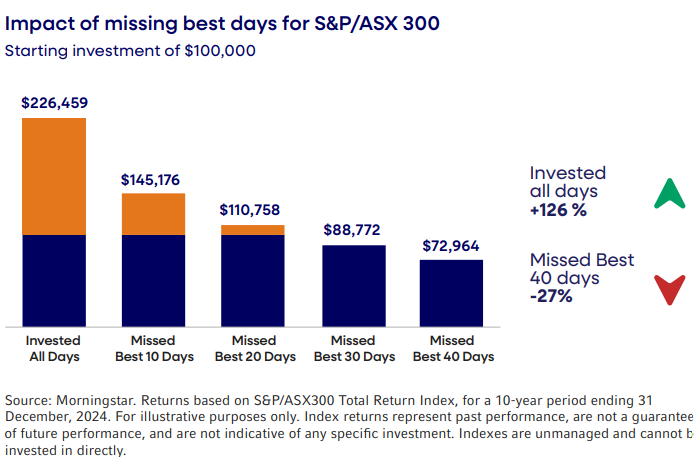
“Behavioural coaching can add about 3.1 per cent a year to a client’s returns by keeping them invested through market swings (based on the S&P 500 index). This illustrates that an adviser’s role goes beyond setting the right strategic asset mix; it includes helping clients stay calm and stick to their plan when markets turn volatile.”
Communicating with clients is important, with 77 per cent of advisers reaching out to their clients at least three times a year.
The report also revealed an ongoing gender imbalance with 62 per cent of unadvised investors being women, while they comprise only 44 per cent of those being advised.
The research also highlighted two essential drivers of client satisfaction, with trust emerging as the foundation of a positive client-adviser relationship.
However, fee transparency remains a challenge, with clients rating advisers lower than advisers rate themselves on clarity. The report says: “Bridging this gap with clearer communication, more client-friendly language and consistent reinforcement of value can help advisers deepen engagement and satisfaction.”

Nicholas Way is a contributing editor at The Inside Adviser and has covered business, retirement, politics, human resources and personal investment over a 50-year career.