Monday 26th May 2025
Australian small-caps: Benchmarks, fees and a quant’s playground
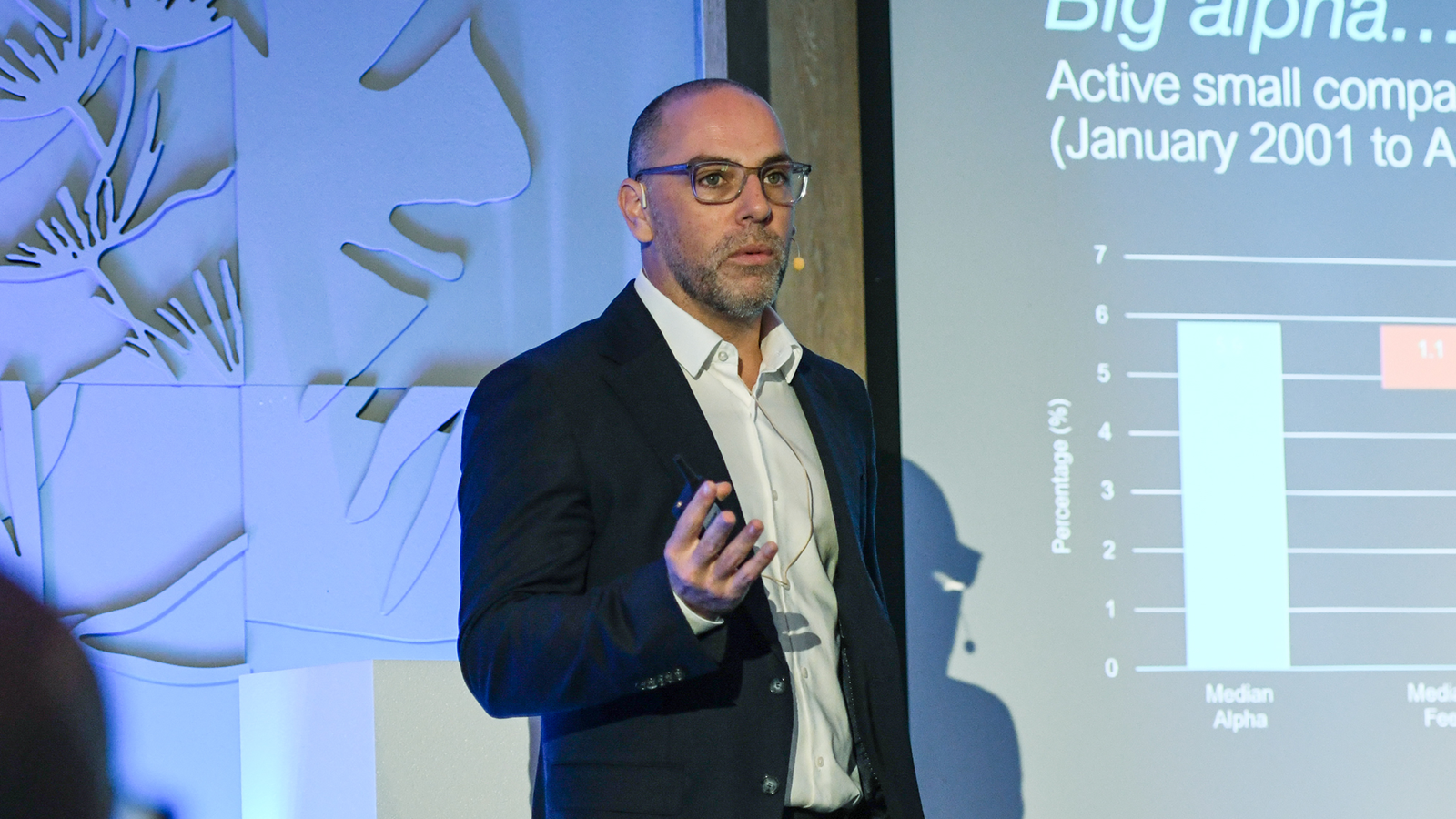
At the recent Investment Leaders Forum, Scott Bennett brought data, deadpan wit, and a surprisingly sharp message for anyone paying passive fees in small caps.
You’ve rarely heard a benchmark deconstructed like Invesco’s Scott Bennett pulled apart the S&P/ASX Small Ordinaries index at the recent Investment Leaders Forum at Byron Bay. Quite simply, said Bennett — who heads multi-asset strategies and factor investing at the firm — the market’s small-cap gauge is broken. And in its fractured state, the Small Ords is providing fertile ground for smart active management — at a cost.
Bennett, with his quant background, built his thesis on evidence, not conjecture. The most consistent alpha in the global equity universe, he said, doesn’t come from hedge funds or Silicon Valley — it comes from Australia’s small-cap active managers. These managers have outperformed their global peers across every metric and every cycle, generating an average annual alpha of 5.9 per cent. And they’re paid accordingly, with fees approaching hedge fund territory.
The mystery, then, is why. Why are these managers able to charge so much, and more importantly, why do they seem to justify it? Bennett offered a view: it’s not just about skill. It’s about the construction of the index itself. Where large-cap indices are weighted toward success — because the biggest companies are often the most profitable and stable — small-cap indices, particularly in Australia, are structurally weighted toward failure.
Bennett broke down that failure into three categories. First, the fallen angels: companies that were once large-cap darlings but have been demoted after sustained underperformance. He pointed to Domino’s Pizza as a recent example. Second, the zombies — businesses so laden with debt that they struggle to meet even basic interest obligations, especially in today’s rate environment. And finally, the glamours — those highly priced small-caps with enormous expectations and little in the way of earnings. These are not outliers; they’re the meat of the index.
In fact, 20 per cent of the small-cap index is made up of fallen angels, a group Bennett referred to as anti-momentum by definition. And despite the term’s cinematic ring, there’s nothing romantic about zombies, either. One in five companies in the index failed to make a profit in 2024. Glamours, meanwhile, are increasingly common. The number of companies trading on more than 30 times sales has more than doubled in the last decade.
These structural flaws give active managers a clear advantage — if they are disciplined. Bennett laid out what he called MQV: a simple model that selects companies based on momentum, quality, and value. Companies that are improving their earnings, maintaining strong balance sheets, and trading at sensible valuations. Applied systematically, MQV produces a long-term return of 5.6 per cent. That happens to be almost identical to the alpha delivered by the median small-cap active manager.
What’s notable about Bennett’s analysis is not just the return numbers, but the reliability of the outperformance. The MQV portfolio beat the index roughly two-thirds of the time over the last 23 years. Conversely, the portfolio of anti-MQV companies — the ones with the worst momentum, weakest balance sheets, and most expensive valuations — lost money. A hypothetical investor putting $100 into that group in 2001 would now have just $66.
Bennett didn’t let active managers off the hook, either. Yes, they’ve beaten the index. But they’ve also captured a disproportionate share of the alpha. With fees averaging 110 basis points and performance fees tacked on, the investor’s net return is eroded. “This isn’t about brilliance,” he suggested. “It’s about avoiding a really bad benchmark.” The implication was clear. Success in Australian small-caps isn’t about finding the next unicorn. It’s about steering clear of the zombies.
His presentation called for a rethink of how allocators approach small-cap investing. Passive, he argued, is structurally flawed in this segment. Active makes sense — but only if it’s value for money. “If you’re going to pay for active management,” he said, “make sure your manager is keeping your interest above their own.” The benchmark is a low bar. The manager still needs to deliver more than a well-designed quant screen.
At a forum heavy on qualitative storytelling, Bennett’s approach stood out for its economy. The logic was mathematical. The tone was clinical. But the message, underneath it all, was human. Don’t be fooled by glamour. Don’t romanticise failure. And don’t pay high fees for what can be done with a spreadsheet and a bit of common sense. That may be the ultimate insight — good investing in small-caps starts with knowing what not to own.

Laurence Parker-Brown is head of content at The Inside Network and managing editor of The Inside Adviser and Investor Strategy News.